Two roulette tables can follow almost identical betting rules while using completely different technology. One may show a live wheel spinning inside a studio, while another displays a digital wheel whose outcome is produced electronically.
That difference is central to Live Dealer Games vs Computer-Generated Casino Games. The choice of format affects game pace, streaming requirements, interaction, outcome processing, and the way technical controls are applied.
Looking beyond graphics and dealer personalities makes it easier to understand what is happening from the moment a wager is accepted until the final result reaches the player’s balance.
Physical Outcomes vs Digital Outcomes
The most fundamental difference appears before the result reaches your screen.
Traditional live dealer games use real physical equipment.
A blackjack card comes from a real shoe. A baccarat dealer handles actual cards. In live roulette, a physical wheel and ball can determine the result.
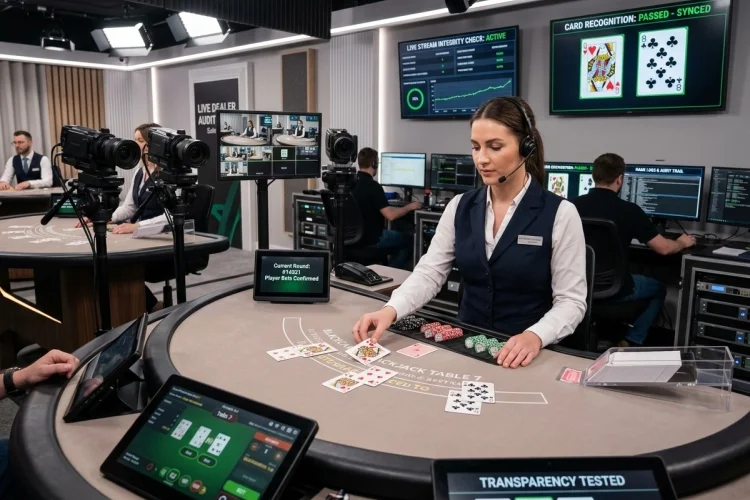
GLI explains that live dealer systems translate these physical transactions into data for the online interface, sometimes using optical character recognition technology.
Computer-generated games take another route.
Software can use an RNG to generate the underlying random result electronically before presenting it through graphics and animation.
The visual experience may imitate a real casino table, but the result-generation process is different.
RNG Games Are Built Around Tested Randomness
The RNG is one of the most important components in many virtual casino games.
It generates values that software maps to specific outcomes.
For example, a virtual roulette game can map a generated value to one of the available wheel results according to its programmed mathematical model.
UK Gambling Commission standards require RNG outputs to be acceptably random and unpredictable. The mapping between random inputs and game outcomes should also follow the declared probabilities and paytables.
GLI’s RNG evaluation process similarly checks systems for unpredictability and possible outcome bias.
This is why a regulated digital casino game is more complicated than a computer simply “choosing” whichever result it wants.
Live Games Replace RNG With Physical Game Events
A conventional live blackjack table does not need software to randomly invent the next card.
The physical card itself is the event.
Technology is still heavily involved, but its role changes.
Cameras broadcast the table, recognition systems translate relevant events into data, and game platforms associate the physical results with player wagers.
GLI describes live dealer outcomes as being determined through real-life actions rather than automated RNG-driven outcome determination.
This distinction also explains why a live stream should not be viewed as merely decorative video.
The actions visible on that video are connected to the actual result of the game.
Game Speed Can Feel Completely Different
Computer-generated games can usually move faster because there is no human dealer waiting between rounds.
A virtual roulette result may be created, displayed, settled, and reset quickly.
Digital blackjack can deal cards instantly and move to the next decision without waiting for a dealer to physically manipulate a shoe.
Live gaming has unavoidable physical steps.
Betting windows need to close. Dealers need to handle equipment. Cards need to be dealt or wheels spun, and results need to be recognised and processed.
That slower pace can make live gaming feel more relaxed or immersive.
On the other hand, players who prefer quick rounds may find a computer-generated version more convenient.
Neither speed automatically changes whether the game is mathematically favourable.
Latency Matters More in Live Games
Live video introduces a technical issue that virtual games do not face in quite the same way: latency.
The physical event occurs in a studio, the video needs to be encoded and transmitted, game information needs to reach the server, and the player’s interface must remain aligned with what appears on screen.
GLI includes synchronicity testing as part of its live dealer evaluation work.
A poorly syncronized system could otherwise create confusing situations, such as an interface updating before or long after the visible table action.
Virtual games have their own network delays, but there is no physical dealer video that must remain synchronized with the software representation.
This makes the live format technically more demanding from a broadcasting perspective.
Human Interaction Changes the Atmosphere
One major attraction of live dealer gaming is the social element.
Players can often see and hear the dealer, while some platforms provide a chat function.
The dealer may announce betting periods, explain results, greet participants, and keep the table moving.
That interaction creates a stronger sense of shared space than most computer-generated games.
Virtual games take the opposite approach.
They are typically quieter, faster, and more private. Players do not need to interact with a dealer or follow another person’s pace.
For someone comparing the two formats, this is less about technical quality and more about personal preference.
Some people enjoy the atmosphere of a studio; others prefer a simple digital interface.
Game Rules Matter More Than the Format
Seeing a human dealer does not automatically give a game better mathematical conditions.
Likewise, computer generation does not automatically mean worse odds.
The actual rules matter.
A live blackjack table paying 6:5 for a blackjack can have different mathematical characteristics from another version paying 3:2. Other rules involving dealer actions, doubling, splitting, or surrender can also affect the house edge.
The same principle applies to digital versions.
UK Gambling Commission standards require applicable game rules and relevant information about the likelihood of winning to be availible to customers before play. That information may include RTP, house edge, or probabilities.
Compare the rules first and the presentation second.
RTP Is a Long-Term Measure in Digital Games
Computer-generated games frequently display an RTP percentage.
Suppose a digital game lists 96% RTP.
This does not mean every $100 session will return $96.
The UK Gambling Commission explains that RTP is an average calculated over a significant amount of play, while random games can produce results above or below that percentage over shorter periods.
Actual performance gradually becomes more meaningful relative to theoretical RTP as the number of completed plays grows.
This matters when comparing casino formats because short-term results provide very little evidence about whether one game type is “better.”
One session at a live roulette table and another at a virtual wheel are not useful statistical comparisons by themselves.
Live Games Require Human Oversight
Physical dealers introduce a different operational challenge: people and equipment have to follow established procedures.
The UK Gambling Commission’s applicable live dealer standards require operations to be independently auditable and include expectations around dealer training, supervision, equipment integrity, secure access, surveillance, and game logging.
That structure helps create records of what happened at the table.
If a questionable card or dealing event needs review, video surveillance and game logs can provide evidence.
Computer-generated games do not need dealer supervision, but they require strong controls around software instead.
That includes testing, monitoring, RNG implementation, and protection of critical systems.
Digital Casino Games Require Strong Software Security
A computer-generated game depends on electronic systems for its entire operation.
Those systems may create random outcomes, record bets, maintain balances, store results, and communicate with player devices.
Security therefore becomes a core part of the product.
UK remote gambling security standards cover systems that process sensitive customer information, transmit random numbers used for game outcomes, store results, or hold the current state of wagers. The requirements draw on relevant controls from ISO/IEC 27001:2022.
Live games also use these kinds of digital systems.
The diffrence is that live operations add physical equipment, cameras, studios, and dealers on top of the electronic infrastructure.
Both Formats Need Reliable Result Processing
Whether the outcome comes from a physical card or an RNG, the casino platform eventually needs to settle the bet.
Applicable UK technical standards require reasonable steps to ensure wagers are accepted, processed, and settled according to published rules.
The platform also needs procedures for technical errors.
If a system incorrectly settles a bet, operators are expected under those standards to address the issue and take appropriate corrective steps.
This highlights an important point: the player’s screen is only one piece of the gaming system.
Behind it are servers, transaction records, game states, and logs used for result procesing.
Connection Problems Affect the Formats Differently
A disconnected live stream can feel particularly dramatic because the physical game may continue even though the player temporarily cannot see it.
However, if the wager has already been accepted and the player can no longer influence the event, UK interruption standards generally say the result should stand.
A similar principle can apply to completed digital wagers.
Closing the browser after pressing spin does not necessarily erase a result that has already been generated on the server.
This is why casinos need persistent game-state and transaction records.
A lost connection affects what you see, but it does not automatically determine whether the underlying wager existed.
Computer-Generated Games Allow More Experimental Features
Software developers have considerable freedom in fully digital environments.
Virtual table games can offer unusual side bets, multi-hand layouts, instant results, animated bonuses, multipliers, or hybrid mechanics that would be awkward to reproduce with a physical dealer.
Live casino developers are increasingly creative too.
Studios can combine real presenters with digital multipliers, augmented graphics, special wheels, or game-show concepts.
The distinction is becoming less visually obvious as technology improves.
Still, the core question remains useful: is the final game event produced physically at the studio, or generated by software?
That tells you more about the underlying format than the graphics do.
Live Dealer Games vs Computer-Generated Casino Games is mainly a comparison between physical and digital outcome systems.
Live tables use real dealers, equipment, streaming, and studio controls, while computer-generated games rely more heavily on software and RNG technology.
When comparing them, examine the actual rules, pace, RTP or house edge, and technical information rather than assuming either format automatically offers better outcomes.