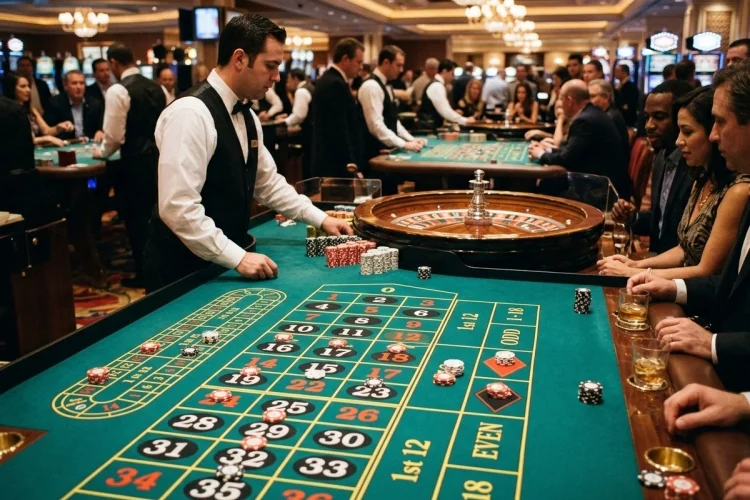
Caribbean Stud Poker looks simple because there is only one major decision after the cards arrive: fold or continue. The interesting part is that this decision can change the mathematical cost of the game significantly.
This second Caribbean Stud Poker Explained guide goes beyond the basic rules.
It looks at why the dealer’s exposed card matters, when weak hands should be folded, how the house edge is calculated, and why optional progressive bets should be viewed separately from the main game.
The goal is understanding the mechanics rather than trying to predict individual hands.
The Game Is Poker Against the House
Unlike Texas Hold’em, Caribbean Stud does not involve trying to take chips from other players.
Each player faces the dealer independently.
The round begins with an Ante, after which both sides receive five cards. You see all five of your own cards, while only one dealer card is initially exposed.
You then choose to fold or place a Raise worth exactly twice the Ante.
This fixed decision structure means there is no bluffing battle.
Your choice is essentially a mathematical judgement about whether the expected value of continuing is better than surrendering the original Ante.
That makes strategy simpler conceptually, even though some borderline hands are surprisingly complex.
Why Folding Matters So Much
Suppose you place a $10 Ante.
If you fold, your maximum loss for that hand is $10.
If you raise, another $20 goes into action.
Now your total exposure becomes $30.
That difference explains why continuing with extremely weak hands is expensive.
Wizard of Odds calculates that blindly raising every hand produces a house edge of roughly 16.607%, compared with about 5.224% when optimal strategy is used under the conventional U.S. paytable.
The decision to fold is therefore not simply giving up.
It is an important part of controlling the mathematical disadvantage.
A weak hand that looks “worth seeing” can be expensive because continuing triples the initial amount at risk.
The Basic Strategy Starts With Two Easy Rules
Most Caribbean Stud hands can be handled using two simple principles.
Wizard of Odds recommends:
Raise with a pair or better.
Fold with less than Ace-King high.
That immediately resolves a large percentage of decisions.
If you have Two Pair, a Straight, a Flush, or another strong hand, continue.
If your best hand is something like Ace-Queen high or King-high, fold.
The challenging area is Ace-King high.
These borderline hands require more information because sometimes continuing is correct and sometimes folding is better.
That is where the dealer’s exposed card becomes relevant.
Why Ace-King Hands Are Complicated
Imagine your hand is Ace-King-Queen-7-3.
You have no pair, but you meet the minimum Ace-King level.
Whether continuing is mathematically preferable can depend on the dealer’s visible card and the ranks of your three remaining cards.
One useful clue occurs when the dealer’s exposed rank matches a card in your hand.
Because you already hold one card of that rank, fewer cards of that rank remain available for the dealer’s hidden cards. That slightly lowers the chance of the dealer creating a pair involving that rank.
Wizard of Odds provides a simplified strategy using these card-removal effects that produces a house edge of about 5.225%, essentially identical to perfect strategy for practical purposes.
Optimal play itself is considerably more complicated.
There is even a detailed decision table devoted specifically to Ace-King hands.
Dealer Qualification Changes the Outcome
The dealer needs Ace-King or better to qualify.
If the dealer fails, the Ante pays 1:1 and the Raise pushes.
This creates an unusual situation.
You might hold a mediocre hand and still receive an Ante win because the dealer does not qualify.
Wizard of Odds calculates the dealer qualification probability at approximately 56.32%, meaning non-qualification occurs a significant portion of the time.
However, that does not justify raising every weak hand.
If you continue too frequently, the additional 2× Raise exposure more than offsets the occasional benefit of dealer non-qualification.
This is why strategy needs to balance qualification probability against the cost of the Raise.
Understanding the House Edge
Under the common U.S. payout table and optimal strategy, Wizard of Odds calculates a house edge of about 5.224% relative to the initial Ante.
That figure needs a little context.
Because players raise on some hands, the average total amount actually placed into action is greater than one Ante unit.
Wizard of Odds therefore also calculates an element of risk of about 2.555%, which compares the expected loss with the average total amount wagered rather than only the original Ante.
This distinction explains why different websites sometimes quote different-looking figures.
They may be measuring different things.
For ordinary players, the most important lesson is simply that strategy matters substantially.
Blindly continuing every hand creates a much worse mathematical position than following a disciplined fold-or-raise approach.
Why Payout Tables Matter
When the dealer qualifies and you beat the dealer, the Ante pays even money while the Raise follows a paytable.
A common structure pays:
1:1 for a pair or other lower winning hand, 2:1 for Two Pair, 3:1 for Three of a Kind, 4:1 for a Straight, 5:1 for a Flush, 7:1 for a Full House, 20:1 for Four of a Kind, 50:1 for a Straight Flush, and 100:1 for a Royal Flush.
Other paytables exist.
Wizard of Odds has documented online versions with different premium-hand payouts and correspondingly different house edges.
This means strategy discussions are most accurate when tied to a specific ruleset.
A game called Caribbean Stud Poker can still have slightly different mathematics if the payout table changes.
Always check the exact schedule rather than assuming the name tells the whole story.
The Progressive Jackpot Is a Separate Bet
Many versions offer a progressive side wager.
This is usually based on your final poker hand rather than whether you beat the dealer in the main game.
That distinction is important.
You could potentially qualify for a side-bet prize even if the dealer outcome is unfavourable, depending on the specific rules.
Wizard of Odds notes that several progressive jackpot paytables exist rather than one universal version.
Evolution’s live version also includes both a progressive jackpot wager and a separate 5+1 Bonus option.
Because side bets have their own payout structures and probabilities, they should be evaluated seperately.
A large jackpot headline tells you the size of a potential top prize. It does not by itself explain the expected return of the side bet.
Strong Hands Are Easy Decisions
One Pair or better is straightforward under standard strategy.
You raise.
Suppose you hold:
K-K-8-5-2.
The pair of Kings comfortably exceeds the borderline Ace-King category.
Likewise, any Two Pair, Three of a Kind, Straight, Flush, or stronger hand is an automatic continuation under the conventional strategy described by Wizard of Odds.
This is one reason Caribbean Stud remains approachable despite its mathematical complexity.
The complicated strategy is concentrated in a relatively narrow group of hands.
Most deals can be resolved immediately.
Weak Hands Should Not Be Chased
One common mistake is continuing simply because one high card looks attractive.
An Ace by itself is not enough.
Neither is a King-high hand.
Wizard of Odds states that raising with less than Ace-King is never part of optimal strategy under the standard rules.
That means hands such as A-Q-J-9-6 or K-Q-J-8-4 should be folded when they contain no pair or better.
It can feel frustrating to surrender the Ante before seeing the dealer’s full hand.
But the alternative requires risking another two Ante units on a mathematically poor position.
Good strategy is often about avoiding extra exposure rather than trying to win every individual deal.
Do Not Confuse Winning Frequency With Good Strategy
A player who raises nearly every hand may occasionally experience a run of dealer non-qualifications and feel that the approach works.
Short-term results can be misleading.
The underlying mathematics are based on all possible card combinations rather than a handful of recent rounds.
Wizard of Odds has analysed almost 20 trillion possible player-and-dealer hand combinations for its standard return calculation.
That analysis shows a dramatic difference between optimal play and blindly raising every hand.
A short winning streak does not overturn that long-run structure.
The correct decision should therefore be based on the cards and published rules rather than whether the previous few hands happened to win.
Caribbean Stud Is Not About Bluffing
Traditional poker advice about bluffing, table image, and reading opponents mostly does not apply here.
The dealer does not decide whether to call your raise.
The dealer simply follows the fixed casino procedure.
This changes the nature of strategy completely.
You are not trying to convince the dealer that your weak hand is strong.
You are deciding whether the known cards justify placing two additional Ante units into the hand.
Pagat describes Caribbean Stud as a banking game rather than conventional poker because every player competes against the bank instead of against other participants.
Thinking of it this way makes the strategy much easier to understand.
Check the Rules Before Playing Online
Online versions can add side bets, change payout tables, or present the game through live dealer or computer-generated formats.
The UK Gambling Commission’s remote technical guidance requires applicable rules, potential prizes, and information concerning the likelihood of winning to be available before gambling occurs.
Use that information.
Check the Raise payout table, dealer qualification rule, progressive jackpot terms, and side-bet conditions.
Do not rely only on a familiar table layout.
Small changes in payouts can alter the game’s expected return, even if the dealing procedure looks identical.
This is especially relevent when moving between different online providers.
This Caribbean Stud Poker Explained guide shows why strategy matters even in a game with only one major decision. Raise strong hands, fold clearly weak ones, and treat Ace-King combinations as the main borderline category.
Dealer qualification and payout tables also shape the mathematics. Before playing, study the exact rules and evaluate optional side bets separately instead of assuming every Caribbean Stud table works identically.