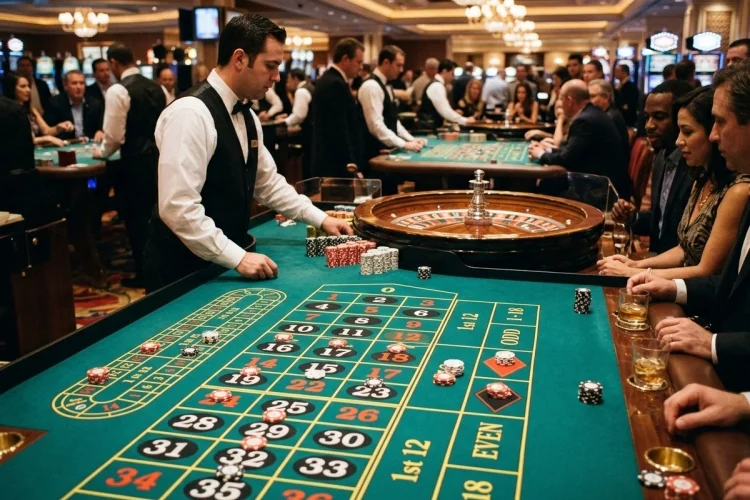
Roulette payouts can seem strange at first. A single-number bet may return 35 times your stake, while a wager covering almost half the wheel pays only the same amount you risked.
The reason is probability. A bet covering fewer pockets is less likely to win, so the casino offers a larger payout. A selection covering many pockets wins more frequently but returns less.
This Inside Bets vs Outside Bets Roulette comparison looks at the numbers behind the table.
Understanding probability will not let you predict the next spin, but it can help you recognise how much risk is attached to each wager and why the advertised payouts differ.
How Roulette Payouts Are Structured
Standard roulette payouts are based on the number of pockets covered by a bet.
A one-number wager pays 35:1. Two numbers pay 17:1, three pay 11:1, four pay 8:1, six pay 5:1, twelve pay 2:1, and most 18-number selections pay 1:1.
These payouts are slightly lower than mathematically fair odds because the wheel includes at least one green zero. That difference creates the casino’s advantage.
Straight Bets: High Payout, Low Probability
A straight bet covers one exact number. It could be 17, 28, zero, or any other individual pocket.
On European roulette, one number has a 1-in-37 chance of appearing, or about 2.70%. The standard profit payout is 35:1, so a successful $2 bet produces $70 in profit and returns the original $2 stake.
On an American wheel, the probability falls to 1 in 38, or roughly 2.63%, because of the additional double zero.
Other Inside Bet Probabilities
A split covers two numbers. On a European wheel, its probability is 2 divided by 37, or approximately 5.41%, and it pays 17:1.
A street covers three numbers and has a probability of about 8.11%. A four-number corner wins approximately 10.81% of the time, while a six-line selection covers around 16.22% of the wheel.
The larger the group becomes, the more frequently it can win. The payout decreases at the same time, keeping the mathematical advantage with the casino.
Outside Bet Probabilities
Red or black, odd or even, and low or high each cover 18 numbers.
On a European wheel, the chance of winning one of these wagers is 18 out of 37, or about 48.65%. It is not a true 50–50 bet because zero belongs to none of those categories.
A dozen or column covers 12 numbers. Its European probability is 12 out of 37, or around 32.43%, and the normal payout is 2:1.
Does an Outside Bet Have a Lower House Edge?
On a standard European wheel, most regular inside and outside wagers have the same approximate house edge of 2.70%.
A straight bet is less likely to win but pays more. Red is more likely to win but pays less. Once the probability and payout are combined, their expected mathematical return is generally the same.
The difference players notice is volatility. Inside bets commonly produce longer losing sequences and occasional larger wins, while broad outside selections produce smaller balance movements.
Why the Extra Zero Matters
American roulette adds a second green pocket without improving the standard payouts.
An even-money bet therefore wins on 18 of 38 pockets, or approximately 47.37%. A dozen wins on 12 of 38, or about 31.58%, and a straight bet wins on only 1 of 38.
The standard American house edge is approximately 5.26%. Choosing a single-zero game is therefore mathematically more favourable than choosing a double-zero version, regardless of whether you prefer inside or outside wagers.
A Simple $10 Example
Imagine placing $10 on black in European roulette. A win produces $10 in profit, while a loss costs the $10 stake.
Now imagine placing $10 on number 17. A successful result produces $350 in profit, but only one pocket wins instead of eighteen.
Neither option is automatically better for a short session. They simply distribute possible wins and losses differently.
Inside bets provide larger potential payouts because they cover fewer pockets. Outside selections win more often because they cover broader groups, but their payouts are smaller.
The house advantage usually comes from the wheel structure rather than the visual location of the wager. A single-zero European table normally offers better mathematical value than a double-zero American game.
Before placing a bet, check the number of pockets, read the payout information, and calculate the complete amount at risk.
Use a fixed budget, avoid increasing stakes after losses, and remember that probability describes long-term patterns – not what must happen next.